
CO2 Laser Treatment | IC Clinic
CO2 laser treatment is used to remove moles, warts, and raised pigmented spots. While it works by ablating the skin surface, the dermis is preserved during the procedure, which means scarring is less likely to occur. It is a treatment method associated with minimal discomfort and low burden on the body.
This page provides information on the characteristics of CO2 laser treatment, pricing at our clinic, and important precautions. We hope you will read through to the end.
At IC Clinic, we propose a treatment plan tailored to each individual patient and provide care with a focus on outcomes.
We take the time to thoroughly understand your concerns and symptoms, so please book a consultation using the button below.
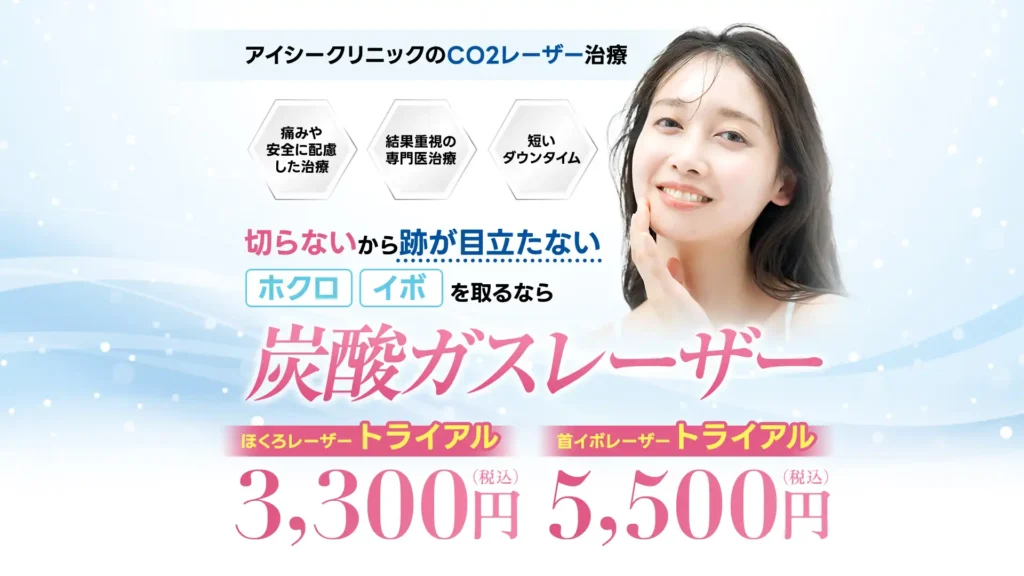
What Is CO2 Laser Treatment? A Treatment for Removing Moles and Warts
CO2 laser treatment is a procedure used to remove moles, warts (including skin tags), and raised pigmented spots. It has minimal impact on the surrounding skin, and because the dermis is preserved in the treated area, scarring is less likely to occur. It may also help improve acne and acne scars.
Although it is a laser-based treatment, discomfort is minimal and the post-treatment impact is generally low, making it a relatively straightforward procedure. Recovery also tends to be faster compared to surgical excision with a scalpel.
Treatment can be applied not only to the face, but also to the décolletage (neck to chest area), the back which is prone to skin concerns, and various other areas of the body.
Who May Benefit from CO2 Laser Treatment
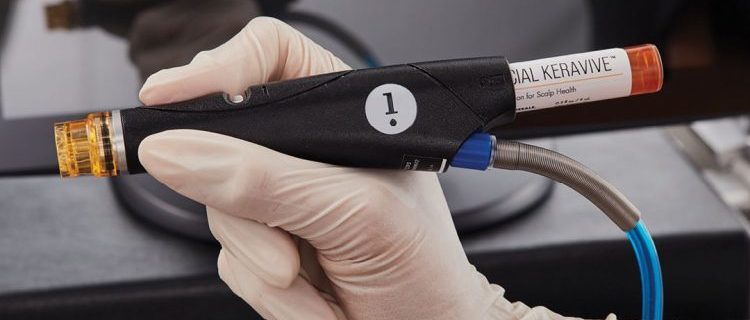
CO2 laser treatment may be suitable for people with the following concerns:
- Those bothered by moles, warts, or pigmented spots
- Those who wish to minimize the impact on surrounding skin
- Those who are sensitive to discomfort during treatment
CO2 laser treatment can address a wide range of skin concerns, including moles, warts, pigmented spots, acne, and acne scars. Because it has minimal impact on the surrounding skin and is less likely to leave scarring, it may be a suitable option for those concerned about the effect of treatment on their skin.
At our clinic, local anesthesia is used during CO2 laser procedures, which helps to reduce discomfort during treatment.
What Areas and Conditions Can CO2 Laser Treat?

Below is an overview of the conditions that can be addressed with CO2 laser treatment and its potential effects. The main treatable conditions include the following three:
- Raised moles and warts
- Pigmented spots and freckles
- Acne and acne scars
We will explain each in detail below.
Removal of Raised Moles and Warts
CO2 laser treatment can be an effective option for raised moles and warts.
When CO2 laser energy is applied to the affected area, the water content within the cells absorbs the energy and undergoes vaporization. This process allows the tissue of the mole or wart to be removed almost instantaneously.
Removal of Pigmented Spots and Freckles
In addition to raised lesions, CO2 laser treatment may also be applicable to conditions such as pigmented spots and freckles.
Pigmented spots and freckles develop when melanin pigment is secreted into the epidermis following UV exposure. Hormonal imbalance and stress can also be contributing factors. CO2 laser treatment can help address melanin pigment that has been secreted and remained in the epidermis.
Because natural resolution can be difficult, CO2 laser treatment may be an effective option for those seeking removal.
Improvement of Acne and Acne Scars
CO2 laser treatment may also help with acne and acne scars.
Adult acne can be triggered by hormonal changes and stress, and it is often difficult to resolve. Once scarring develops, it can be hard to fade and may persist for a long time.
CO2 laser treatment may help address persistent acne and lingering acne scars.
Characteristics of CO2 Laser Treatment — What About Discomfort?

Here we introduce the key characteristics of CO2 laser treatment. Some patients may have concerns about discomfort given that it is a laser-based procedure. The main features are summarized below.
- Discomfort is generally minimal
- Reacts to water content in tissue
- Bleeding is minimal in most cases
- Recovery of the treated area tends to be relatively quick
Let us look at each characteristic in more detail.
① Discomfort Is Generally Minimal
Because the laser must be applied directly to the affected area, CO2 laser treatment is performed after administering anesthesia — either by injection or topical cream. While many clinics state on their websites that “there is almost no pain,” individual experiences can vary, and it would not be accurate to say it is entirely without discomfort.
That said, any discomfort experienced is typically described as similar to a needle prick, and redness or a mild stinging sensation after treatment generally subsides within about a day.
※ Patients with sensitive skin are encouraged to consult with their treating physician before the procedure.
② Reacts to Water Content in Tissue
One of the key characteristics of CO2 laser is that it reacts to water.
Skin contains a high amount of water. When the laser is applied, the water stored within the skin cells of the treated area reacts to the energy and generates heat. This heat causes the water to vaporize almost instantaneously, resulting in ablation of the skin tissue.
③ Bleeding Is Minimal in Most Cases
Although CO2 laser treatment involves ablating the skin to remove the affected tissue, bleeding is minimal in most cases.
When the laser ablates the skin, some damage to blood vessels is unavoidable. However, the thermal coagulation effect of the laser causes any affected vessels to seal almost immediately.
Surgical excision with a scalpel typically results in bleeding, but with CO2 laser treatment, this is generally much less of a concern.
④ Recovery Tends to Be Faster Compared to Surgical Excision
Recovery of the treated area following CO2 laser treatment is generally considered faster than after surgical excision with a scalpel.
While CO2 laser treatment works through the vaporization of water, this process is limited to the surface of the skin. Because the dermis and surrounding skin are not damaged, faster recovery can be expected.
CO2 laser treatment may be a suitable option for those who are mindful of the post-treatment recovery process.
How Much Does CO2 Laser Treatment Cost? Please Note That Cosmetic Treatments Are Not Covered by Insurance

Pricing for CO2 laser treatment at our clinic varies depending on the type and size of the mole or wart being treated.
Pricing for Mole and Wart Treatment
For pricing on CO2 laser treatment for moles and warts, please refer to the price list for warts, moles, and skin tags.
Pricing for Verruca Vulgaris (Common Wart) Treatment
Verruca vulgaris, also known as a common wart, is a viral wart that tends to develop on the fingers and around the nails. It is caused by the HPV virus, appears frequently in children, and has a rough surface texture.
For pricing on CO2 laser treatment for verruca vulgaris, please refer to the price list for warts, moles, and skin tags.
Pricing for Seborrheic Keratosis Treatment
Seborrheic keratosis refers to slightly raised, wart-like lesions that resemble pigmented spots. It is a benign skin growth that can begin appearing as early as one’s thirties and tends to increase with age. Also known as senile warts or age spots, it is a form of skin aging that affects almost everyone by their eighties.
Unlike verruca vulgaris, seborrheic keratosis is not caused by a virus and therefore cannot be transmitted to others. For pricing on CO2 laser treatment for seborrheic keratosis, please refer to the price list for warts, moles, and skin tags.
Pricing for Soft Fibroma (Acrochordon / Skin Tag) Treatment
Soft fibromas (acrochordons), commonly known as skin tags, are small skin protrusions that tend to develop in areas subject to friction, such as the neck and underarms. Small ones can sometimes be removed with scissors, but CO2 laser treatment may be a preferable option when cosmetic outcomes are a consideration.
Like seborrheic keratosis, acrochordons typically begin appearing in one’s thirties and tend to increase with age. For pricing on CO2 laser treatment for soft fibromas, please refer to the price list for warts, moles, and skin tags.
What Is the CO2 Laser Treatment Process? Post-Treatment Recovery Overview

Below is an overview of the CO2 laser treatment process and recovery timeline.
We will also discuss the condition of the treated area 10 days and several months after CO2 laser treatment. The treatment process consists of the following five steps:
- Examination and consultation for the treatment area
- Application of anesthesia to the treatment area
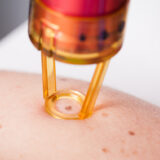
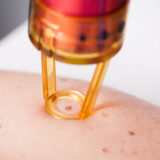
- Laser irradiation
- Prescription of aftercare medication and monitoring of recovery
- Post-treatment recovery (how long until the skin returns to normal)
Let us walk through each step.
① Examination and Consultation for the Treatment Area
You will first undergo a medical examination and consultation regarding the area to be treated. After assessing the condition of the affected area, we will explain the potential outcomes you may expect from treatment, as well as the associated risks.
If you have any concerns or questions about CO2 laser treatment, please feel free to ask at this stage. We want to ensure you feel fully informed and at ease before proceeding with treatment.
② Application of Anesthesia to the Treatment Area
Prior to CO2 laser treatment, local anesthesia will be applied to the treatment area. Anesthesia may be administered via topical cream or injection. If you have any concerns about the method of anesthesia, please let our staff know during your initial consultation.
The anesthesia helps to reduce discomfort during the procedure.
③ Laser Irradiation
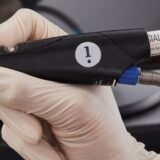
Once anesthesia has been applied, the CO2 laser irradiation begins. Treatment time varies depending on the condition of the area being treated, but in most cases, irradiation is completed in approximately 5 to 10 minutes.
With the anesthesia in effect, discomfort during the procedure is generally minimal. Bleeding is also minimal in most cases, allowing you to undergo treatment with confidence.
④ Prescription of Aftercare Medication and Monitoring of Recovery
After treatment, an antiseptic ointment will be applied and aftercare medication will be prescribed. Because UV protection of the treated area is important following the procedure, we will provide thorough guidance on sun care.
Monitoring of recovery is required for a period after treatment. A scab will typically form within 2 to 3 days, and a protective tape should be applied for approximately 10 days to shield the area from sun exposure. As it may take several months for the skin to fully return to its original tone, please continue to apply UV protection and use any prescribed medications consistently throughout this period.
⑤ Post-Treatment Recovery (How Long Until the Skin Returns to Normal)
The scab will typically begin to shed around 10 days after treatment. Please avoid forcibly removing the scab, as doing so may delay healing.
Once the scab has shed, apply sunscreen to the treated area for approximately 3 months. The treated area may appear pink and slightly indented, but the skin generally returns to its normal appearance within 3 to 6 months.
※ We recommend using a mineral (non-chemical) sunscreen with an SPF of 30 or higher.
Three Important Precautions for CO2 Laser Treatment
While CO2 laser treatment offers a number of benefits, there are also important precautions to be aware of. Please review the following points.
① Not Covered by Health Insurance
When performed for cosmetic purposes, CO2 laser treatment is not covered by health insurance and is considered a private-pay (out-of-pocket) treatment. As a result, the cost of treatment tends to be higher.
② UV Protection Is Required to Prevent Sun Exposure to the Treated Area
Following CO2 laser treatment, UV protection is necessary to prevent sun exposure to the treated area. Sun exposure may diminish the results of the treatment.
We will explain the importance of protecting the treated area from UV exposure during your consultation and again after your procedure.
③ Temporary Indentation or Marks May Occur During the Downtime Period
Depending on the severity of the condition, deeply rooted warts or moles may require complete removal from the base, and the ablation of the treated tissue may result in a temporary indentation or mark in the skin.
Any indentation that occurs is temporary and should resolve over time.
For CO2 Laser Removal of Warts and Moles, Consult IC Clinic
CO2 laser treatment is a procedure that ablates only the affected skin tissue while minimizing impact on the surrounding skin.
It may be effective for addressing skin concerns such as moles, warts, and pigmented spots. Furthermore, CO2 laser treatment is characterized by its ability to preserve the dermis of the treated area, as well as its use of local anesthesia to help reduce discomfort during the procedure.
CO2 laser treatment is less likely to leave lasting marks, and the skin often returns to its normal appearance within 3 to 6 months following treatment. If you are concerned about moles, warts, pigmented spots, or similar conditions, please feel free to consult with us.
At IC Clinic, we propose a treatment plan tailored to each individual patient and provide care with a focus on outcomes.
We take the time to thoroughly understand your concerns and symptoms, so please book a consultation using the button below.
References
- Japan Society for Laser Surgery and Medicine. “Guidelines for Dermatological Laser Treatment (2017 Edition).” Journal of Japan Society for Laser Surgery and Medicine, 2017.
- Japanese Dermatological Association. “Diagnostic Criteria and Treatment Guidelines for Pigmented Nevi and Nevus Syndromes.” Journal of the Japanese Dermatological Association, 2019.
- Japan Society of Plastic and Reconstructive Surgery. “Research on the Safety of CO2 Laser Treatment for Skin Tumors.” Journal of Japan Society of Plastic and Reconstructive Surgery, 2018.
- Japanese Society of Aesthetic Surgery. “Guidelines for Prevention of Complications in Laser Treatment.” 2020 Edition.
- Japan Society for Photodynamic Medicine. “Biological Mechanisms and Clinical Applications of CO2 Laser.” Society Journal, 2019.
※ The above references are provided as sources of medical evidence. For actual diagnosis and treatment decisions, please consult a qualified specialist.