
It is estimated that approximately 1 in 10 people in Japan has underarm odor (axillary osmidrosis).Axillary osmidrosis, which causes a distinctive odor from the underarms, can be a deeply distressing condition.Because odor is a sensitive issue that others rarely point out, many people tend to be slow to recognize it in themselves.
However, once you become aware that you may have axillary osmidrosis, treatment and odor management become possible. On this page, we introduce the Quadracut procedure, one of the surgical options for treating axillary osmidrosis.We also explain the causes of axillary osmidrosis and compare it with other treatment options, so please read to the end.
By reading this page, you will gain a deeper understanding of axillary osmidrosis treatment and be better equipped to determine whether the Quadracut procedure may be right for you.
At our clinic, we propose treatment plans tailored to each individual patient and provide care with a focus on results.
We will carefully listen to your concerns and symptoms, so please use the button below to book a consultation.
Table of Contents
- 1 Addressing Your Axillary Osmidrosis Concerns with the Quadracut Procedure
- 2 What Is the Quadracut Procedure (Formula Shaver System)? Comparing Its Effectiveness with the Excision Method
- 3 How Does the Quadracut Surgery Work? A 6-Step Overview
- 4 What Is Recovery Like After the Quadracut Procedure? Relatively Short Downtime
- 5 Treatment Costs for the Quadracut Procedure at IC Clinic
- 6 Who Is the Quadracut Procedure Recommended For? 3 Profiles
- 7 4 Key Features of the Quadracut Procedure
- 7.1 Feature ①: Minimal Scarring
- 7.2 Feature ②: No Hospitalization Required
- 7.3 Feature ③: Hair Removal Effects Can Be Expected
- 7.4 Feature ④: Low Recurrence Rate
- 8 2 Important Considerations for the Quadracut Procedure
- 8.1 Consideration ①: High Cost Due to No Insurance Coverage
- 8.2 Consideration ②: Some Patients May Experience Post-Operative Hyperpigmentation
- 9 Visit IC Clinic for Axillary Osmidrosis Treatment with the Quadracut Procedure
Addressing Your Axillary Osmidrosis Concerns with the Quadracut Procedure
The Quadracut procedure is a treatment designed to address the concerns associated with axillary osmidrosis.Axillary osmidrosis can cause an unpleasant body odor that may interfere with interpersonal relationships.
Axillary osmidrosis is a condition in which a distinctive odor is produced from beneath the arms. The intensity of the odor can vary depending on the amount of perspiration.While it is said to be less common among Japanese people, it often develops during puberty.
The characteristic odor associated with axillary osmidrosis is caused by sweat secreted from the apocrine glands and the bacteria that act upon it. The sweat produced by the apocrine glands contains components such as fatty acids and ammonia; when bacteria break down these fatty acids, odor is generated.
Apocrine glands are located within the hair follicles of certain areas of the body, including the underarms.This means that the greater the amount of hair in the area, the more likely axillary osmidrosis is to develop or become more pronounced.
What Is the Quadracut Procedure (Formula Shaver System)? Comparing Its Effectiveness with the Excision Method
The Quadracut procedure is one of the surgical options available for treating axillary osmidrosis. Here, we compare its effectiveness with other procedures. Please refer to the table below, which summarizes the main treatment options for axillary osmidrosis.
| Quadracut | Excision Method / Flap Method | miraDry | Suction Method | Ultrasound Method | |
|---|---|---|---|---|---|
| Incision Size | Approx. 1 cm | Approx. 10–15 cm | None | Approx. 1–2 cm | Approx. 3 cm |
| Surgery Time | 40–60 min | 60–90 min | 60 min | 60–90 min | 60 min |
| Recurrence | Low | Low | Low | Possible | Low |
| Hair Removal Effect | Yes | Limited | None | Limited | Limited |
| Insurance Coverage | Not covered | Covered | Not covered | Not covered | Covered |
| Estimated Cost | Approx. ¥400,000 | Approx. ¥40,000 | Approx. ¥330,000 | Approx. ¥150,000 | Approx. ¥50,000 |
Like the excision method, the Quadracut procedure involves making an incision in the underarm skin and removing the sweat glands and hair follicles that cause axillary osmidrosis.In terms of recurrence rate, it offers comparable outcomes to the excision method.
The excision method is covered by insurance, which helps keep costs down; however, it has the drawback of leaving a larger scar.
With the Quadracut procedure, the skin incision is only about 1 cm.It differs from the excision method in that it results in minimal scarring and also offers hair removal benefits.
However,because it is not covered by insurance, the cost is higher.For those who wish to avoid visible scarring, miraDry is another option that requires no incision. We encourage you to understand the features of each treatment and consult with a physician to find the approach that suits you.
How Does the Quadracut Surgery Work? A 6-Step Overview
The procedure for the Quadracut surgery is as follows.
- Disinfection and anesthesia
- A 5–10 mm incision is made in the underarm skin
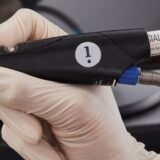
- Sweat glands are removed as thoroughly as possible using a needle instrument (Quadracutter)
- Any remaining sweat glands are flushed out
- The incision is sutured
- The wound is secured with gauze and a bandage
Local anesthesia is administered to the underarm during the procedure, so discomfort is minimal.Through the small incision of approximately 5 mm, the eccrine glands, apocrine glands, and hair follicles that cause axillary osmidrosis are removed.
Because the incision is small, only about one suture is needed, and the wound is simply secured with gauze and a bandage.The entire procedure, including preparation, takes approximately 40 to 60 minutes.
What Is Recovery Like After the Quadracut Procedure? Relatively Short Downtime
The post-operative recovery timeline for the Quadracut procedure is as follows.
| Day of Surgery |
|
|---|---|
| Next Day – 1 Week After |
|
| 1 Week After |
|
| 2 Weeks After |
|
A notable feature of the Quadracut procedure is its relatively short downtime compared to the excision method.Because the incision is small, hospitalization is not required.After the procedure, patients will need to visit the clinic several times for gauze changes, disinfection, suture removal, and post-operative check-ups.
Sutures are typically removed within about one week, and the gauze can also be taken off at that point, allowing patients to return to their normal routine from the day after suture removal. However, as recovery varies among individuals, please always consult your physician before resuming bathing or exercise.
Treatment Costs for the Quadracut Procedure at IC Clinic

For detailed pricing of the Quadracut procedure at our clinic, please refer to the fee schedule for Underarm Odor (Axillary Osmidrosis) & Hyperhidrosis.
Who Is the Quadracut Procedure Recommended For? 3 Profiles

Based on the details of the Quadracut procedure described above, it may be a suitable option for individuals who fall into one of the following three profiles.
- Those who want to minimize scarring from surgery
- Elementary school-aged children struggling with axillary osmidrosis
- Those who wish to return to their normal daily routine as soon as possible after surgery
The Quadracut procedure involves one of the smallest incisions among surgical treatments for axillary osmidrosis. Because the incision is small and blood loss is minimal, while several follow-up visits are needed after surgery,hospitalization is not required.The physical burden of the procedure is also low, meaningit can be performed even on younger patients such as elementary school-aged children.
For sedentary work such as office-based roles, returning to work from the day after surgery may be possible.That said, please note that it typically takes about one week after surgery before physically demanding work or exercise can be resumed.
※ The condition of the wound after surgery varies among individuals.
4 Key Features of the Quadracut Procedure

Here we introduce four key features of the Quadracut procedure.
- Minimal scarring
- No hospitalization required
- Hair removal effects can be expected
- Low recurrence rate
Let us look at each of these four features in detail.
Feature ①: Minimal Scarring
A key feature of the Quadracut procedure is that it results in significantly smaller scars compared to conventional surgery. The traditional excision method requires an incision of 10–15 cm, whereas the Quadracut procedure requires only about 1 cm.
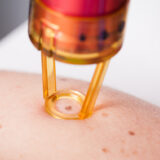
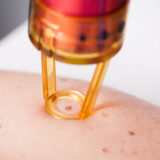
This is becausethe use of a needle instrument (Quadracutter) with a diameter of just 3 mm makes it possible to remove subcutaneous sweat glands such as the apocrine and eccrine glands through a very small incision.
Feature ②: No Hospitalization Required
Because the Quadracut procedure involves a small incision and minimal bleeding, hospitalization is not necessary.
With the conventional excision method, surgical scissors are used to remove the sweat glands, resulting in a larger incision area and greater concern about bleeding — both of which necessitated hospitalization. Post-operatively, the underarm had to be immobilized with a splint and bandage, placing a considerable burden on the patient.
The Quadracut procedure leaves a small wound that only requires gauze secured with tape after surgery, resulting in fewer movement restrictions. As a result,patients in sedentary roles may be able to return to work as early as the day after surgery.
Feature ③: Hair Removal Effects Can Be Expected
The apocrine glands, which are the source of the odor associated with axillary osmidrosis, are tissue that is difficult to see with the naked eye. Surrounding them are subcutaneous structures including hair follicles.
Because the Quadracut procedureremoves hair follicles along with the apocrine glands, hair reduction effects can also be expected. Once removed, hair follicles, like sweat glands, do not regenerate.
This means treatment for axillary osmidrosis may also be accompanied by long-term hair reduction benefits.
Feature ④: Low Recurrence Rate
With the conventional excision method, apocrine glands were removed manually. However, because they are minute structures,surgical scissors were difficult to maneuver precisely, making it inevitable that small amounts of tissue would be left behind.
The Quadracut procedure results in significantly less residual tissue compared to the excision method. This is because the 3 mm diameter needle instrument (Quadracutter) is able to comprehensively remove the apocrine glands along with the surrounding tissue.With less sweat gland tissue left behind, the likelihood of recurrence is also considered to be lower.
Since sweat glands that have been removed do not generally regenerate, outcomes comparable to or potentially better than the excision method can be expected.
2 Important Considerations for the Quadracut Procedure

While the Quadracut procedure has notable benefits, there are also important considerations to be aware of.Please make sure you fully understand these points before deciding whether to proceed with the Quadracut procedure.
The two main considerations for the Quadracut procedure are as follows.
- Higher cost due to no insurance coverage
- Some patients may experience hyperpigmentation during post-operative recovery
Let us look at each in turn.
Consideration ①: Higher Cost Due to No Insurance Coverage
The main drawback of the Quadracut procedure is that it is not covered by insurance.The surgical fee for both underarms is approximately ¥400,000.
By contrast,the excision method is covered by insurance, making it possible to have surgery on both underarms for approximately ¥40,000 — roughly one-tenth of the cost of the Quadracut procedure. We encourage you to carefully consider your priorities: treatment cost versus speed of recovery and extent of scarring.
Consideration ②: Some Patients May Experience Post-Operative Hyperpigmentation
The Quadracut procedure may in some cases cause darkening of the skin — known as hyperpigmentation — after surgery. However, this typically improves gradually over the course of several months, so it is generally not a cause for concern.
For those who are particularly concerned,aftercare options such as skin-brightening creams are available— please keep this in mind.
Visit IC Clinic for Axillary Osmidrosis Treatment with the Quadracut Procedure
The Quadracut procedure is a surgical treatment for axillary osmidrosis characterized by minimal scarring and a relatively short procedure time.
Because the incision is small and the physical burden is low, hospitalization is not required and the procedure can be performed even on younger patients. However,since it is not covered by insurance, the cost is higher compared to other surgical options.
If left untreated, axillary osmidrosis can potentially affect interpersonal relationships. Odor-related concerns are difficult to discuss with others, and many people carry a considerable emotional burden as a result.
That said, axillary osmidrosis can be managed with appropriate treatment.In addition to the Quadracut procedure introduced here, there are several other treatment options available. At our clinic, we propose the most suitable treatment plan based on each patient’s individual symptoms. If you are concerned about axillary osmidrosis, please feel free to consult us.
At our clinic, we propose treatment plans tailored to each individual patient and provide care with a focus on results.
We will carefully listen to your concerns and symptoms, so please use the button below to book a consultation.