
“What is spot removal laser treatment?”
“I’d like to learn more about the irradiation modes and side effects of spot removal laser.”
If these questions sound familiar, read on.
Spot removal laser treatment is a therapy that destroys melanin pigment to improve pigmented spots, melasma, and other forms of hyperpigmentation. It is available in a variety of irradiation modes, including laser facial and laser toning.
On this page, we explain the treatment process, side effects, and six irradiation modes of spot removal laser therapy. By the end, you will have a clearer picture of whether this treatment may be right for you.
At our clinic, we propose a treatment plan suited to each individual patient and provide care focused on results. We take the time to listen carefully to your concerns and symptoms, so please use the button below to book a consultation.
Table of Contents
- 1 What Is Spot Removal Laser? A Treatment That Destroys Melanin Pigment
- 1.1 Types of Pigmented Spots: Melasma, ADM, Senile Lentigines, and More
- 1.2 What Causes Pigmented Spots and Hyperpigmentation? Melanin Production from UV Exposure, Dryness, and Other Factors
- 1.3 Who May Benefit from Spot Removal Laser Treatment
- 2 Six Irradiation Modes of Spot Removal Laser
- 2.1 Laser Facial | A Treatment Using Low-Output Laser
- 2.2 Laser Toning | A Treatment That Gradually Reduces Melanin
- 2.3 Fractional Laser | Also Addresses Enlarged Pores and Dullness
- 2.4 Q-Switch Mode | Short-Pulse Mode of the Q-Switch YAG Laser
- 2.5 Pico Toning | A Pico Laser Mode That Irradiates the Entire Skin Surface
- 2.6 Pico Spot | Concentrated Irradiation for Spot and Freckle Reduction
- 3 Differences Between At-Home Laser Devices and Clinical Treatment
- 4 Side Effects and Downtime of Spot Removal Laser Treatment
- 5 If Spots Don’t Fade After Laser Treatment — Post-Treatment Hyperpigmentation
- 6 The Spot Removal Laser Treatment Process
- 7 Post-Treatment Progress and Aftercare | Using Ointment and Sun Protection
- 8 Pricing for Spot Removal Laser at Our Clinic
- 9 Frequently Asked Questions About Spot Removal Laser Treatment
- 9.1 Q. How long does treatment take for full-face spot removal?
- 9.2 Q. Is spot removal laser treatment at a dermatology clinic covered by insurance?
- 9.3 Q. Does spot removal laser treatment hurt?
- 9.4 Q. From which session might I begin to notice results?
- 10 Contact IC Clinic for Pigmented Spot and Hyperpigmentation Treatment
What Is Spot Removal Laser? A Treatment That Destroys Melanin Pigment

Spot removal laser treatment is a therapy that uses laser light to destroy the melanin pigment responsible for pigmented spots.
Melanin is produced when melanocytes inside the skin are stimulated by UV exposure. When this melanin is not shed through the skin’s natural renewal cycle and instead remains in the skin, it appears as a pigmented spot.
Spot removal laser reacts with melanin pigment. It is expected to offer benefits such as improvement of spots, dullness, and melasma.
Types of Pigmented Spots: Melasma, ADM, Senile Lentigines, and More
There are several types of pigmented spots. The characteristics of each and the treatments that may be appropriate are as follows.
| Type of Spot | Characteristics | Suitable Treatment |
|---|---|---|
| Pigmented Spots (Senile Lentigines / Solar Lentigo) |
Circular, brown spots | ・Laser Toning ・Q-Switch Mode ・Pico Toning ・Pico Spot |
| Melasma | Symmetrical spots centered around the cheekbones | ・Laser Toning ・Pico Toning |
| ADM | Spots on both cheeks, slightly larger than freckles | ・Q-Switch Mode ・Pico Spot |
| Post-Inflammatory Hyperpigmentation | Spots that appear as a result of skin inflammation | ・Laser Toning ・Pico Toning |
| Seborrheic Keratosis (Age Warts) |
An advanced form of senile lentigo | ・Fractional Laser (CO₂ Laser) |
Our clinic provides treatment for all the types of pigmented spots listed above.
Our physicians will propose a treatment approach suited to each patient’s individual symptoms, so please feel free to consult IC Clinic if you are considering treatment.
What Causes Pigmented Spots and Hyperpigmentation? Melanin Production from UV Exposure, Dryness, and Other Factors
The main causes of pigmented spots include the following five factors.
- UV exposure
- Dryness
- Stress
- Hormonal imbalance
- Aging
Among these, one of the primary causes is the production of melanin pigment triggered by UV exposure. Melanin is produced to protect the skin from ultraviolet rays.
When UV exposure causes excessive melanin to be produced, melanin that should have been shed during the skin’s renewal process remains in the skin, leading to hyperpigmentation and the formation of spots.
Spot removal laser treatment uses laser light to destroy melanin pigment. It is a treatment approach that may help improve spots, melasma, and hyperpigmentation.
Who May Benefit from Spot Removal Laser Treatment
Spot removal laser treatment may be suitable for those with the following concerns.
- Those who want to address persistent pigmented spots
- Those who want to improve hyperpigmentation
- Those who want to improve melasma
- Those who want brighter, healthier-looking skin
and more.
Spot removal laser treatment may help improve a range of skin concerns including spots and dullness.
However, the most suitable treatment approach varies depending on the condition, so please first consult a clinic about the concerns you would like to address.
Popular article:
Recommended Aesthetic Clinics for Spot Removal Laser — Dermatology or Cosmetic Surgery? Is Insurance Coverage Available? Pricing and Expected Benefits Explained.
Six Irradiation Modes of Spot Removal Laser

Spot removal laser therapy is available in a range of irradiation modes. The key differences among the main spot removal laser options are as follows.
| Name | Laser Facial | Laser Toning | Fractional Laser | Q-Switch Mode | Pico Toning | Pico Spot |
|---|---|---|---|---|---|---|
| Characteristics | Treatment using low-output laser | Treatment that gradually reduces melanin | Treatment that aims to improve skin quality by harnessing the body’s natural healing ability | Treatment designed to minimize damage to healthy skin | Pico laser mode that irradiates the entire skin surface with low-output laser | Irradiation mode that concentrates the beam on the target area for spot reduction |
| Expected Benefits | ・Improvement of spots and dullness ・Improvement of clogged or darkened pores ・Improvement of acne scars |
・Improvement of spots and melasma ・Improvement of freckles ・Improvement of enlarged pores and darkened pores |
・Improvement of spots ・Improvement of scars and acne scars ・Improvement of enlarged pores and darkened pores and more |
・Improvement of spots, moles, and melasma ・Improvement of birthmarks ・Tightening of pores and more |
・Improvement of melasma ・Improvement of dullness and spots ・Improvement of enlarged pores and more |
・Improvement of spots and freckles ・Improvement of pigmentation from cosmetic tattooing and more |
| Side Effects | ・Redness, swelling, or stinging at the treatment site ・Hyperpigmentation |
・Redness or swelling at the treatment site ・Hypopigmentation (white spots) |
・Redness or swelling at the treatment site ・Skin roughness |
・Hyperpigmentation ・Hypopigmentation ・Redness or swelling at the treatment site |
・Hyperpigmentation ・Hypopigmentation (white spots) |
・Hyperpigmentation |
Below, we explain the characteristics of each mode in detail.
Laser Facial | A Treatment Using Low-Output Laser
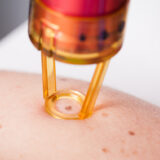
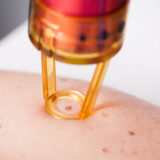
Laser facial is a treatment in which low-output laser is directed at the target area to help make spots and dullness less noticeable.
During treatment, an alexandrite laser is applied. Because the irradiation is performed at a low output simultaneously with cooling gas, discomfort tends to be minimal.
In addition, the treatment may promote collagen production, contributing to a skin-beautifying effect. It is a treatment approach that may help address a variety of skin concerns, including spots and freckles.
For a detailed explanation of laser facial treatment, please also visit the page linked below.
What Is Laser Facial? Four Expected Benefits, the Treatment Process, and Pricing Explained.
Laser Toning | A Treatment That Gradually Reduces Melanin
Laser toning is a treatment in which a medical-grade laser is applied at low power to gradually reduce the melanin pigment that contributes to spots and melasma.
It may offer benefits for reducing spots, freckles, and melasma.
In addition, scabbing after treatment tends to be less likely. The treatment can also be performed on areas of the body beyond the face, allowing concerns on areas such as the underarms and elbows to be addressed.
For a detailed explanation of laser toning, please also visit the page linked below.
Can Laser Toning Reduce Spots and Melasma? Two Expected Benefits, Pricing, and Number of Sessions Explained.
Fractional Laser | Also Addresses Enlarged Pores and Skin Texture

Fractional laser is a treatment that delivers thermal energy to the deeper layers of the skin via micro laser beams, aiming to improve skin quality by harnessing the body’s natural healing ability.
Skin that has been affected by the micro laser beams undergoes cell division in the process of repair. This promotes the reconstruction and proliferation of collagen.
Through cellular renewal, this approach may help lead the skin toward a clearer, more even complexion. It can also address a range of skin quality concerns, including spots, sagging, enlarged pores, and darkened pores.
For a detailed explanation of fractional laser, please also visit the page linked below.
What Is Fractional Laser? Three Expected Skin Care Benefits, Including Improvement of Scars and Enlarged Pores.
Q-Switch Mode | Short-Pulse Mode of the Q-Switch YAG Laser
Q-switch mode refers to the short-pulse mode of the Q-switch YAG laser. The Q-switch YAG laser may offer benefits for improving spots, moles, freckles, and similar concerns.
Another feature of the Q-switch is its ability to adjust the pulse width — the duration of each laser pulse. This allows energy at an appropriate output level to be delivered to melanin pigment.
As a result, it may be possible to address spots and freckles while minimizing damage to healthy surrounding skin.
For a detailed explanation of Q-switch mode, please also visit the page linked below.
What Is the Q-Switch YAG Laser (Spectra)? Three Benefits Including Melasma Reduction and Post-Treatment Progress.
Pico Toning | A Pico Laser Mode That Irradiates the Entire Skin Surface
Pico toning is a pico laser irradiation mode that applies low-output laser across the entire skin surface to gradually reduce melanin pigment.
Because low-output irradiation is repeated in a way that avoids over-stimulating melanin pigment, this mode may be effective not only for spots and dullness but also for melasma.
In addition, because melanin pigment is disrupted by shock waves rather than heat, discomfort during treatment tends to be minimal. Downtime is also generally short.
For a detailed explanation of pico toning, please also visit the page linked below.
Is Pico Toning Effective for Spots and Melasma? Treatment Process, Progress, and Treatment Intervals Explained.
Pico Spot | Concentrated Irradiation for Spot and Freckle Reduction
Pico spot is a pico laser irradiation mode that concentrates the beam on specific areas of concern — such as spots and freckles — to reduce them.
Because a higher-output laser is used, spots and freckles may be addressed in a shorter treatment time.
In addition, downtime tends to be relatively short, and makeup can typically be applied immediately after treatment. The risk of post-inflammatory hyperpigmentation following treatment is also considered to be low.
For a detailed explanation of pico spot, please also visit the page linked below.
What Is Pico Laser? Three Irradiation Modes, Expected Benefits, and Potential Risks Explained.
Differences Between At-Home Laser Devices and Clinical Treatment
Spot reduction can also be approached at home using a consumer laser beauty device. The main differences between at-home devices and clinical treatment are the following four points.
- Expected benefits
- Discomfort
- Downtime
- Cost
Clinical laser treatment uses laser light to destroy melanin pigment. At-home laser beauty devices, on the other hand, work by activating the skin and promoting cell turnover to gradually improve skin quality over time.
Discomfort tends to be minimal, though results take more time to appear. For those looking to address spots and melasma more efficiently, clinical treatment may be worth considering.
Side Effects and Downtime of Spot Removal Laser Treatment
Possible side effects of spot removal laser treatment include the following.
- Small rashes or pimples
- Bruising
- Redness, swelling, or stinging at the treatment site
Swelling and discomfort typically settle within a few hours, while rashes and bruising generally resolve within approximately two weeks.
In addition, sun exposure may cause melasma or spots that have faded to become more noticeable again, so please use a sunscreen (UV protection) until the skin tone has fully settled.
If symptoms persist, please consult the clinic where you received your treatment.
If Spots Don’t Fade After Laser Treatment — Post-Treatment Hyperpigmentation
After spot removal laser treatment, scabs typically fall away within approximately one to two weeks, revealing new skin underneath. However, post-inflammatory hyperpigmentation (sometimes referred to as rebound pigmentation) may occur as a result of the inflammation caused by laser irradiation.
This does not indicate that treatment has been unsuccessful.
Post-inflammatory hyperpigmentation is distinct from the original pigmented spot. It may darken and peak around one month after treatment, then gradually fade over time.
An important consideration during this period is to avoid irritating the area. Rubbing the treated area vigorously can worsen hyperpigmentation, so please take care even when applying topical medications.
The Spot Removal Laser Treatment Process

At our clinic, spot removal laser treatment follows the process outlined below.
- Consultation and Examination
We begin by listening to your concerns. We discuss your individual goals — such as reducing spots or melasma — and work with you to determine a treatment plan. - Treatment
Laser is applied to the areas of concern, such as spots or melasma. For patients who are anxious about discomfort, topical anesthetic cream may be applied beforehand. - Aftercare
Following the session, the skin surface is gently wiped clean and the treated area is protected with gauze or tape. Any scabs that form after treatment will fall away naturally — please do not attempt to remove them manually.
Makeup, facial cleansing, hair washing, showering, and bathing are all permitted from the day of treatment.
However, please take care not to rub the treated area vigorously.
Post-Treatment Progress and Aftercare | Using Ointment and Sun Protection

After spot removal laser treatment, the skin tends to become significantly drier, so thorough moisturizing is important. Sun exposure may also cause melasma that has faded to darken again, or spots to become more noticeable.
For this reason, please use the ointment and sunscreen (UV protection) prescribed after your session, and take care to protect the treated area from UV exposure.
After treatment, allow at least three weeks before your next visit, and proceed with subsequent sessions based on consultation with your treating physician.
Pricing for Spot Removal Laser at Our Clinic
Pricing for spot removal laser treatment at our clinic varies depending on the treatment goal and number of sessions.
Please refer to the relevant price list below for details based on your specific concern.
Price List for Pigmented Spots & Melasma
Price List for Acne Scars (Indented)
Price List for Acne Scars (Redness)
Price List for Skin Beautification & Firmness
Price List for Wrinkles
Price List for Body Darkening
Price List for Clogged Pores
Frequently Asked Questions About Spot Removal Laser Treatment

Here we have compiled frequently asked questions about spot removal laser treatment.
Q. How long does treatment take for full-face spot removal?
The treatment duration varies depending on the patient’s condition and the type of medical laser used. As a general guide, each individual session takes approximately 15 to 30 minutes.
We examine each patient’s condition individually and propose an appropriate treatment approach, so please feel free to consult our clinic first.
Q. Is spot removal laser treatment at a dermatology clinic covered by insurance?
Spot removal laser treatment is not covered by health insurance for the following conditions.
- Senile lentigines
- Freckles
- Melasma
- Post-inflammatory hyperpigmentation
and others.
These conditions are not covered by insurance because treatment aimed at lightening or removing spots is considered to be cosmetic in nature.
On the other hand, treatment for conditions such as Ota’s nevus, flat nevus (nevus spilus), and aberrant Mongolian spots may be eligible for insurance coverage in some cases. Please check with the clinic you plan to visit regarding insurance applicability.
Q. Does spot removal laser treatment hurt?

The level of discomfort during treatment varies depending on the patient’s condition and the type of laser used. While individual experiences differ, it is often described as a sensation similar to being snapped with a rubber band.
At our clinic, topical anesthetic cream is available for patients who are concerned about discomfort during spot removal laser treatment.
Q. From which session might I begin to notice results?
The estimated number of sessions before results may be noticed is as follows.
| Condition | Estimated Number of Sessions |
|---|---|
| Faint Spots | Approximately 1 session |
| Darker Spots | Approximately 3–5 sessions |
| Melasma | Approximately 5–10 sessions |
Please note that the number of sessions before results are noticed varies depending on each patient’s condition and individual characteristics. We recommend proceeding with treatment in consultation with your treating physician.
Contact IC Clinic for Pigmented Spot and Hyperpigmentation Treatment
Spot removal laser treatment is a therapy that uses laser light to destroy the melanin pigment responsible for pigmented spots. It may help address a range of skin concerns, including spots and hyperpigmentation.
The types of pigmented spots for which laser treatment may be beneficial include the following.
- Senile lentigines
- Melasma
- ADM
- Post-inflammatory hyperpigmentation
- Seborrheic keratosis
At our clinic, we listen carefully to each patient’s concerns and propose a treatment plan suited to the individual. If you are troubled by spots or melasma and are considering treatment, we invite you to consult IC Clinic.
At our clinic, we propose a treatment plan suited to each individual patient and provide care focused on results. We take the time to listen carefully to your concerns and symptoms, so please use the button below to book a consultation.