
This page is supervised and written by specialist physicians at IC Clinic.
Photofacial (IPL) with ICON: A Complete Guide

Pigmented spots and acne can develop due to factors such as aging and UV exposure. Many people feel concerned about skin issues yet have given up hope of improving them. However, these concerns can often be addressed with the right treatment.
This page introduces the ICON device — one of the latest IPL systems used in photofacial (IPL) treatments — and covers its benefits, features, and important considerations. Please read to the end for a full overview.
By reading this page, you will learn about the photofacial (IPL) treatment process and the skin concerns that can be addressed with the ICON device. We also cover key points to be aware of, so please familiarise yourself with them before undergoing treatment.
At our clinic, we propose a treatment plan tailored to each patient’s individual needs and focus on delivering results.
We take the time to listen carefully to your concerns and symptoms, so please book a consultation using the button below.
What Is Photofacial (IPL)? A Treatment for a Range of Skin Concerns

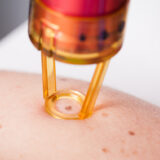
Photofacial (IPL) treatment uses IPL (Intense Pulsed Light) — a specialised flash of light — applied directly to the skin. By targeting melanin pigment and haemoglobin, which are responsible for many skin concerns, it is a treatment approach that can address multiple skin issues simultaneously, including pigmented spots, freckles, dullness, and acne.
The treatment causes minimal damage to the skin and involves a relatively short recovery period — so much so that make-up can typically be applied immediately after the session. Read on to learn about the photofacial (IPL) treatment process and the conditions that can be addressed with the latest ICON device.
What Is ICON M22? The Latest Device for Photofacial (IPL) Treatment
ICON is one of the latest IPL treatment devices available. Equipped with a highly effective cooling system, it is capable of delivering IPL flashes at higher output levels.
By adjusting the settings, the device can be used to help improve a range of skin concerns, including pigmented spots (age spots, freckles, and dullness), facial redness (rosacea, acne, acne scars, and post-surgical redness).
The device is characterised by rapid delivery of light pulses and a reduced risk of burns during treatment.
Six Benefits of Photofacial (IPL) with ICON

Below are six conditions and benefits that photofacial (IPL) treatment with ICON may address.
- Pigmented spots & freckles
- Enlarged pores
- Acne
- Acne scars & facial redness
- Fine lines
- Skin firmness & elasticity
Let’s look at each in turn.
Reduction of Pigmented Spots & Freckles
Pigmented spots and freckles are primarily caused by pigment deposition due to aging and UV exposure. IPL light penetrates deep into the skin to stimulate skin activity, helping to lift deposited pigment and gradually fade it through the skin’s natural metabolic processes.
Combining IPL with iontophoresis — a treatment that infuses high-concentration vitamin C into the skin — may allow for a more responsive approach to treating pigmented spots and freckles.
Minimising Enlarged Pores
IPL light supports collagen production, helping to tighten pores that have become enlarged due to aging and other factors. As skin texture becomes more refined, overall skin firmness may improve and the appearance of enlarged pores can be reduced.
Helping to Improve Acne via IPL’s Antibacterial Action
The IPL light used in photofacial (IPL) treatment acts on Cutibacterium acnes (C. acnes), the bacteria associated with acne.
By targeting acne-causing bacteria, the treatment may help reduce the likelihood of new breakouts forming, potentially leading to improvement of acne over time.
In addition, photofacial (IPL) treatment can support skin cell turnover. As the skin surface renews itself, the likelihood of clogged pores and new breakouts may be reduced.
Improvement of Acne Scars & Facial Redness
Facial redness is often caused by dilated blood vessels near the skin surface. IPL light can help constrict excess superficial capillaries, which may reduce the appearance of redness on the face.
It may also be effective for acne scars where redness results from visible capillaries beneath the skin surface, helping to make the redness less noticeable.
For cases with particularly pronounced redness, V-Beam — a treatment that targets haemoglobin pigment within blood vessels — may also be a suitable option.
Improvement of Fine Lines
Key external causes of fine lines include UV exposure and dryness. UV rays can contribute to the deterioration of collagen and elastin deep within the skin.
When the skin becomes dry, the surface of the stratum corneum is more prone to flaking, creating small gaps. As moisture evaporates through these gaps, the skin may become thinner and less supple, leading to the formation of fine lines.
Because photofacial (IPL) light penetrates deep into the skin, it can help activate fibroblasts and support collagen production, which may contribute to improving the appearance of fine lines.
Supporting Skin Firmness & Elasticity
Photofacial (IPL) treatment filters out harmful UV wavelengths and may contribute to a clearer, more radiant complexion.
Some patients notice an improvement in their skin’s condition after treatment; however, it is generally difficult to see significant improvement in skin firmness after just one or two sessions. In most cases, multiple treatments are required.
In practice, patients who undergo ongoing photofacial (IPL) treatment tend to notice improvements in skin texture and appearance over time. Combining treatment with iontophoresis may also help enhance skin brightening effects.
Photofacial (IPL) with ICON — Pricing at IC Clinic
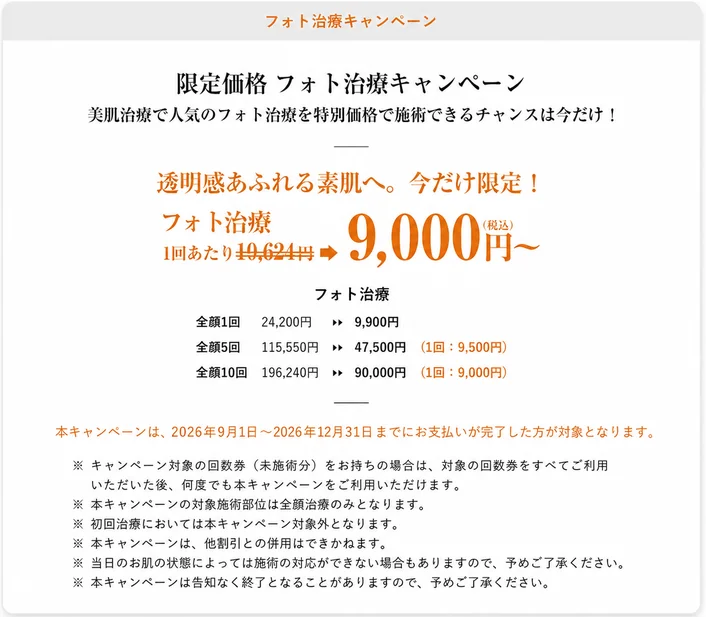
Pricing for photofacial (IPL) treatment at our clinic varies depending on the treatment area and number of sessions.
Please refer to the relevant price lists below according to your specific concern.
- Skin Beautification & Radiance — Price List
- Wrinkles — Price List
- Pigmented Spots & Melasma — Price List
- Acne Scars (Redness) — Price List
- Redness & Facial Redness — Price List
- Body Darkening — Price List
- Clogged Pores — Price List
The Photofacial (IPL) Treatment Process at IC Clinic
Here is an overview of the photofacial (IPL) treatment process at our clinic, broken down into four steps.
- Initial consultation
- Pre-treatment explanation
- Photofacial (IPL) treatment
- Follow-up & aftercare

① Initial Consultation
We begin with an examination and consultation to assess your skin condition. Please feel free to share any concerns you have, such as acne scars, freckles, or pigmented spots.
Appointments are generally made by reservation; however, same-day walk-in treatment may be possible if a treatment room is available. We recommend booking in advance by phone or online to minimise waiting time.
② Pre-Treatment Explanation
Your attending physician will explain the procedure and, based on the information gathered during your consultation, determine the appropriate type and intensity of IPL for your treatment. A consent form will be provided, so please read and listen carefully to the treatment details before signing.
Afterwards, the treatment area will be cleansed using cleansing oil to remove any make-up, followed by face washing. As IPL can also react to fine facial hair and may cause some discomfort, we recommend shaving the treatment area in advance.
③ Photofacial (IPL) Treatment
As preparation before the treatment, a cooling gel is applied to the skin and protective goggles are provided to shield your eyes from the IPL light.
A test pulse at a lower intensity is then delivered to assess your skin’s response, and the intensity is gradually adjusted to suit your skin type before the full treatment is applied to the target area.
During the treatment, you may feel a mild snapping sensation, similar to the flick of a rubber band, though strong pain is not commonly reported. Depending on skin condition, approximately 100 to 150 pulses are delivered across the full face, followed by around 15 minutes of skin cooling.
④ Follow-Up & Aftercare
Make-up and face washing are permitted on the day of treatment. For the first few days following the procedure, we recommend using both a sunscreen and an anti-inflammatory cream.
Recovery time after treatment is relatively short, and redness or swelling is generally not a prolonged concern. Around 7 to 10 days after treatment, the treated area may temporarily appear darker or more raised. This will naturally flake away within a few days, so please avoid touching or picking at it.
Five Points to Be Aware of with Photofacial (IPL) Treatment

As with any treatment, there are considerations to keep in mind with photofacial (IPL). Here are five important points to understand before undergoing treatment.
- Treatment is not suitable for those who are pregnant or have active skin inflammation
- Excessive sun exposure should be avoided for one month before and after treatment
- Some discomfort may be felt during the light pulses
- A few days after treatment, pigmented spots or freckles may temporarily appear more prominent, similar to a scab
- To achieve sufficient results, a course of 5 to 6 sessions is generally recommended
Let’s look at each in turn.
Treatment Is Not Suitable for Those Who Are Pregnant or Have Active Skin Inflammation
Treatment cannot be provided to patients who fall under any of the following categories.
- Those who are pregnant
- Those with photosensitivity
- Those with a history of epileptic seizures
- Those who have a suntan or are planning to suntan
- Those with severe skin inflammation
Please make sure you have a clear understanding of your own condition before consulting us about photofacial (IPL) treatment.
Excessive Sun Exposure Should Be Avoided for One Month Before and After Treatment
The skin is particularly sensitive after treatment. To minimise UV exposure, it is important to use sunscreen and avoid prolonged direct sunlight.
Rather than undergoing treatment during summer, we recommend scheduling a course of sessions from autumn through to winter. Having treatment in autumn and winter, while allowing the skin to rest during summer, is generally considered a suitable approach.
Some Discomfort May Be Felt During the Light Pulses
Cooling gel and other measures are used during treatment to help minimise discomfort.
Some patients may experience a mild snapping sensation, similar to the flick of a rubber band, though this is generally manageable. That said, sensitivity to discomfort varies between individuals, so please be aware that some degree of discomfort is possible.
Pigmented Spots or Freckles May Temporarily Appear More Prominent a Few Days After Treatment
A few days after treatment, pigmented spots or freckles may appear darker and seem to rise to the surface.
This is a sign that the treated area is in the process of recovering. The melanin pigment rises to the surface and will naturally flake away within a few days. If this is a concern, it can be covered with make-up in the meantime.
A Course of 5 to 6 Sessions Is Generally Needed to Achieve Sufficient Results
Many patients notice some improvement after a single photofacial (IPL) session. However, taking into account the skin’s natural cell renewal cycle, it is generally considered ideal to continue treatment with approximately 5 to 6 sessions at monthly intervals.
Even after visible improvement has been achieved, attending the clinic every few months for maintenance sessions may help sustain the results over time.
For Comprehensive Skin Improvement, Consult IC Clinic
Photofacial (IPL) treatment uses IPL — a specialised light — and is a treatment option often well-suited to those considering laser-based treatment for the first time.
It may help improve a range of skin concerns, including pigmented spots, acne scars, and fine lines, and can also support skin firmness and elasticity.
However, it is important to be aware that the treated area may temporarily appear more raised after treatment, and UV exposure must be avoided during the recovery period. Understanding these points in advance is important.
At our clinic, we use the ICON device, allowing us to provide treatment with reduced discomfort. If you have any skin concerns, please feel free to consult us.
At our clinic, we propose a treatment plan tailored to each patient’s individual needs and focus on delivering results.
We take the time to listen carefully to your concerns and symptoms, so please book a consultation using the button below.