
“Does medical laser hair removal really work?”
“How do medical laser hair removal devices work, and what are the differences between them?”
If you have been wondering about these questions, read on.
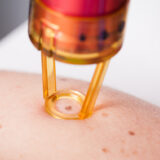
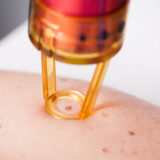
Medical laser hair removal works by directing a laser that targets hair-follicle tissue onto the skin, preventing new hair from growing back. Compared with light-based hair removal performed at beauty salons, medical laser hair removal offers a higher level of hair reduction.
This page explains how medical laser hair removal works, what results you can expect, and how treatments are carried out.
At our clinic, we assess each patient individually and propose a treatment plan tailored to your needs.
We take the time to listen carefully to your concerns, so please book a consultation using the button below.
Table of Contents
- 1 What Is Medical Laser Hair Removal? Long-Term Hair Reduction in a Relatively Short Period
- 1.1 Medical Laser Hair Removal Targets Melanin Pigment
- 1.2 Treatment Cannot Be Applied to Tanned Skin, Moles, or Areas of Pigmentation
- 2 Two Types of Medical Laser Hair Removal: Thermal Destruction and Gradual Heating
- 2.1 How Thermal Destruction (Single-Shot) Laser Removes Hair
- 2.2 How Gradual-Heating Laser Removes Hair
- 3 Is Medical Laser Hair Removal Ineffective? Why Hair May Not Fall Out After Treatment
- 4 How Many Sessions Are Needed? VIO, Underarms, and the Face Typically Require More Sessions
- 4.1 How Long Does Treatment Take? Sessions Are Typically Spaced About 2 Months Apart
- 4.2 What Is the Hair Growth Cycle? Laser Hair Removal Is Most Effective During the Anagen (Growth) Phase
- 4.3 Results and Number of Sessions Vary Depending on the Device Used
- 5 Medical Laser Hair Removal Is Also Available for Men’s Beard Hair
- 6 Differences Between Medical Laser Hair Removal and Salon-Based Light Hair Removal
- 7 Side Effects of Medical Laser Hair Removal: Redness, Paradoxical Thickening, Folliculitis, and More
- 8 Treatment Process and What to Expect
- 9 Pricing for Medical Laser Hair Removal
- 10 Frequently Asked Questions About Medical Laser Hair Removal
- 10.1 Q. How much discomfort is involved in medical laser hair removal?
- 10.2 Q. Is it true that medical laser hair removal can improve enlarged pores and underarm odor?
- 10.3 Q. Can I receive laser hair removal while pregnant or during my period?
- 11 Considering Medical Laser Hair Removal? Consult Our Clinic
What Is Medical Laser Hair Removal? Long-Term Hair Reduction in a Relatively Short Period

Among the various hair removal methods available, medical laser hair removal is one that may offer a high level of effectiveness.
There are broadly three types of hair removal:
- Medical laser hair removal
- Electrolysis (needle hair removal)
- Light-based hair removal
Of these, light-based hair removal is performed at beauty salons. It operates at a lower output than medical laser devices and does not provide lasting hair removal.
Electrolysis can achieve permanent hair removal, but it requires a long treatment period and tends to involve considerable discomfort.
By contrast, medical laser hair removal can achieve long-term hair removal and typically involves less discomfort than electrolysis. In recent years it has become more affordable, making it an accessible option for many people.
Medical Laser Hair Removal Targets Melanin Pigment
Medical laser hair removal uses a laser that reacts to the dark melanin pigment in hair follicles.
When melanin absorbs the laser light, it converts the energy to heat, which destroys the surrounding tissue. Once the dermal papilla and hair matrix cells responsible for hair growth are destroyed, the hair naturally falls out.
Some people may feel apprehensive about lasers, but medical hair removal targets melanin specifically, with minimal impact on the surrounding skin.
Depending on the device used, discomfort during treatment can also be reduced.
Treatment Cannot Be Applied to Tanned Skin, Moles, or Areas of Pigmentation
Laser cannot be applied to areas of suntan or to moles.
Medical lasers react to the melanin pigment in hair follicles. Because melanin is also present in tanned skin and moles, directing the laser at these areas could cause unnecessary damage.
To reduce the risk of burns or inflammation, treatment may not be possible depending on the degree of sun exposure.
Skin concerns such as age spots or darkened areas may also prevent treatment in some cases. If you are concerned about the condition of your skin, please discuss this with our doctor during your consultation.
Two Types of Medical Laser Hair Removal: Thermal Destruction and Gradual Heating

Medical laser hair removal devices use one of two irradiation methods:
- Thermal destruction (single-shot method)
- Gradual heating method
The two methods differ in their hair removal effect and level of discomfort, so choosing the right device for your needs is important. Each method is explained in the sections below.
How Thermal Destruction (Single-Shot) Laser Removes Hair
Thermal destruction (single-shot) laser hair removal uses high-output irradiation to destroy the hair-growth tissue within the follicle.
The mechanism works as follows:
- A laser that reacts to melanin pigment is fired in an instant pulse
- The dermal papilla and hair matrix cells within the follicle are destroyed
- With the hair-growth tissue gone, the hair naturally falls out
Thermal destruction targets the dermal papilla and hair matrix cells at the source of hair growth. While some discomfort is felt during irradiation, it can efficiently address thick, coarse hair.
On the other hand, it may not produce sufficient results on fine vellus hairs with low melanin content. Patients with darker skin tones may also have a higher risk of burns and might not be suitable candidates for this method.
How Gradual-Heating Laser Removes Hair
Gradual-heating lasers use repeated low-output irradiation to destroy an area known as the bulge region.
The hair removal mechanism works as follows:
- Low-output laser pulses are delivered in rapid succession
- The bulge region — which directs hair growth — is gradually destroyed
- Without signals from the bulge region, hair stops growing
A key feature of the gradual-heating laser is reduced discomfort.
The bulge region targeted by this method is located in the shallower layers of the skin. Because heat is built up gently through low-output pulses, discomfort can be significantly reduced compared with the thermal destruction method.
It can also be effective on fine vellus hairs and darker skin tones — areas where the thermal destruction method may be less suitable — though results develop gradually over repeated sessions rather than with hair falling out immediately after treatment.
Is Medical Laser Hair Removal Ineffective? Why Hair May Not Fall Out After Treatment

If you feel you are not noticing results from medical laser hair removal, the following may be reasons to consider:
- You have not yet had enough sessions
- Not enough time has passed since your last session
- The laser output may have been insufficient
Laser hair removal can offer a high level of effectiveness, but hair removal cannot be achieved in a single session. Multiple sessions are needed to align with the hair growth cycle — the natural cycle in which hair is replaced.
In addition, results vary between individuals based on hair thickness and density, and hair typically falls out several weeks after treatment.
Understanding that hair removal takes time, please continue attending sessions even if you do not notice immediate results after treatment.
How Many Sessions Are Needed? VIO, Underarms, and the Face Typically Require More Sessions

The number of sessions needed to see results from medical laser hair removal varies depending on the treatment area.
The table below shows the average number of sessions by body area.
| Area | Hair maintenance becomes easier | Smooth skin including vellus hair |
|---|---|---|
| Full Body | 8 sessions+ | 10 sessions+ |
| Underarms | 5 sessions+ | 6 sessions+ |
| VIO | 5 sessions+ | 6 sessions+ |
| Face | 8 sessions+ | 10 sessions+ |
Even with medical hair removal’s high level of effectiveness, it is uncommon to notice a significant difference after just the first or second session. Results vary among individuals, but gradual changes typically become noticeable from around the third session onward.
Areas with naturally thicker or denser hair tend to show results earlier. If your goal is to remove hair down to fine vellus hair, please plan for a course of around 10 or more sessions.
How Long Does Treatment Take? Sessions Are Typically Spaced About 2 Months Apart
While this varies by clinic, sessions are typically recommended approximately once every 2 months.
You may wonder whether sessions can be scheduled more frequently, but reducing the interval between sessions is not expected to improve hair removal results. This is related to the hair growth cycle — the natural cycle of hair replacement.
Shortening the interval also increases the risk of skin concerns such as burns or inflammation, so please follow the treatment schedule recommended by your clinic.
The next section explains the hair growth cycle, which is an important factor in hair removal.
What Is the Hair Growth Cycle? Laser Hair Removal Is Most Effective During the Anagen (Growth) Phase
The hair growth cycle refers to the natural cycle in which body hair is replaced. It varies by area — for the underarms, for example, the cycle is approximately 2 months.
The hair growth cycle consists of three stages: the telogen (resting) phase, the anagen (growth) phase, and the catagen (regression) phase. Laser hair removal is effective only on hairs in the anagen phase — which accounts for approximately 20% of hairs at any given time.
To remove the remaining hair, it is necessary to wait between sessions for other hairs to enter the growth phase.
Results and Number of Sessions Vary Depending on the Device Used
The effectiveness of medical hair removal also depends on the device used.
The table below compares commonly used diode lasers, alexandrite lasers, and Nd:YAG lasers.
| Diode Laser | Alexandrite Laser | Nd:YAG Laser | |
|---|---|---|---|
| Wavelength | 755 nm (varies by device) |
808 nm | 1,064 nm |
| Method | Thermal destruction | Thermal destruction / Gradual heating | Thermal destruction |
| Coarse hair | Suitable | Well suited | Well suited |
| Tanned skin | Applicable | Not applicable | Applicable |
| Features | ・Less absorbed by the epidermis ・May be effective on darker skin tones |
・Strongly reactive to melanin pigment ・Results tend to be noticeable |
・Can reach deeply rooted hair ・Well suited for VIO and beard hair |
As shown above, the diode laser is well suited for fine vellus hair on areas such as the back and nape of the neck, while the alexandrite laser is well suited for coarser hair on areas such as the underarms and VIO.
The Nd:YAG laser is well suited for deeply rooted hair such as VIO and beard hair.
The “Soprano Titanium” device available at IC Clinic is capable of delivering irradiation at diode, alexandrite, and Nd:YAG laser wavelengths.
For more information about the Soprano Titanium, please see the page below.
What Is the Soprano Titanium? A Hair Removal Device That May Offer Effective Results on Vellus Hair With Minimal Discomfort
Medical Laser Hair Removal Is Also Available for Men’s Beard Hair

Laser hair removal can also be effective for men’s beard hair.
Many men are bothered by thick, dense beard growth, and high-output medical laser treatment can work toward long-term hair reduction in these areas.
Generally, shaving becomes noticeably easier after around 5 to 6 sessions, and smoother skin may be achievable with 10 or more sessions.
Please note that the beard area tends to involve more discomfort during treatment. The risk of side effects such as redness and inflammation is also higher, so please take care of your skin on an ongoing basis.
Differences Between Medical Laser Hair Removal and Salon-Based Light Hair Removal
Medical laser hair removal can complete the process in fewer sessions compared with light-based hair removal.
Please refer to the table below for a comparison of laser and light hair removal.
| Laser Hair Removal | Light Hair Removal | |
|---|---|---|
| Coverage | Targeted area irradiation | Broad area irradiation |
| Effect | Long-term hair removal | Temporary hair reduction |
| Discomfort | Moderate | Minimal |
| Number of sessions | 5–10 sessions | 12–18 sessions |
| Treatment period | 1–2 years | 2–3 years |
Because medical hair removal uses high-output lasers, it can complete treatment in fewer sessions and over a shorter period than light hair removal.
For those who want to minimise treatment time or seek long-term hair removal, medical laser hair removal is worth considering.
Choose the method that best suits your lifestyle so you can feel confident about your decision in years to come.
Side Effects of Medical Laser Hair Removal: Redness, Paradoxical Hair Thickening, Folliculitis, and More

Serious side effects from laser hair removal are not commonly reported; however, the following symptoms may occasionally occur:
- Burns or inflammation
- Paradoxical hair thickening (hypertrichosis)
- Folliculitis
Paradoxical hair thickening is a phenomenon in which hair becomes coarser after treatment. The exact cause is not fully understood, but it tends to occur more often in areas with fine vellus hair, such as the back and nape of the neck.
Folliculitis is a skin condition characterised by small bumps on the skin. It can occur when bacteria proliferate in hair follicles that have been affected by laser treatment.
If any of these side effects appear, please consult your clinic.
Treatment Process and What to Expect

Medical laser hair removal is generally carried out in the following steps:
- Examination and consultation
The doctor will assess your skin condition. Please feel free to ask any questions you have in advance. - Irradiation
Treatment is carried out while monitoring your skin condition and comfort. Anaesthetic cream is available for those who are sensitive to discomfort. - Post-treatment care
To help prevent inflammation, icing (cooling) or application of an ointment will be carried out as needed. - Departure
Your skin will be in a sensitive state after treatment, so please continue skincare at home.
Treatment time varies by clinic, but as a general guide, both underarms take approximately 5 to 10 minutes, and both lower legs take approximately 30 minutes.
Sessions are typically spaced about 2 months apart. If the clinic tends to be busy, we recommend booking your next appointment before leaving after each session.
Pricing for Medical Laser Hair Removal
IC Clinic offers a range of medical hair removal plans covering the full body as well as individual treatment areas.
For detailed pricing, please refer to the medical hair removal price list.
Frequently Asked Questions About Medical Laser Hair Removal

Below, we answer some frequently asked questions about medical laser hair removal.
Q. How much discomfort is involved in medical laser hair removal?
With thermal destruction lasers, the sensation is commonly described as similar to being snapped with a rubber band.
Any discomfort is temporary, and swelling after treatment is uncommon. Redness or itching may occasionally occur, but these typically subside within 1 to 2 weeks.
The underarms and VIO area tend to involve more discomfort due to thicker, denser hair. Some clinics can prescribe anaesthetic cream to help reduce discomfort during treatment.
The gradual-heating laser also involves less discomfort than the thermal destruction method. IC Clinic offers the gradual-heating device “Soprano Titanium,” so please feel free to ask about this option if you are concerned about discomfort.
Q. Is it true that medical laser hair removal can improve enlarged pores and underarm odor?
There is a possibility that pores may become less noticeable following medical laser treatment.
This is thought to occur because, once hair is removed, sebum and debris are less likely to accumulate in the follicles, which may allow open pores to tighten over time. No longer needing to perform self-grooming can also help reduce skin irritation.
There is also a possibility that laser energy affecting the sweat glands may help reduce symptoms of underarm odor (axillary osmidrosis) and excessive underarm sweating.
However, these are secondary outcomes and cannot be guaranteed for every individual. If you are concerned about enlarged pores or underarm odor, we recommend consulting a specialist for dedicated treatment.
Q. Can I receive laser hair removal while pregnant or during my period?
To avoid skin concerns, laser hair removal is not performed during pregnancy.
While medical laser energy does not directly affect the fetus, hormonal balance is unstable during pregnancy. A significant increase in female hormones can cause increased body hair growth, which may also reduce the effectiveness of medical hair removal.
Similarly, it is advisable to avoid medical hair removal during your period, when hormonal balance fluctuates. Unexpected skin reactions may occur, so if your period coincides with a scheduled appointment, we recommend rescheduling.
Considering Medical Laser Hair Removal? Consult Our Clinic

Medical laser hair removal works by directing a laser that targets melanin pigment at the skin to destroy the tissue surrounding the hair follicle. Unlike light-based hair removal at beauty salons, it can work toward long-term hair removal.
While this varies by area, hair maintenance generally becomes easier after approximately 5 to 8 sessions, and hair removal including fine vellus hair may be achievable after 6 to 10 sessions.
IC Clinic offers a gradual-heating hair removal device designed to minimise discomfort. We will suggest a treatment plan suited to your individual needs, so please visit us for a consultation.
At our clinic, we assess each patient individually and propose a treatment plan tailored to your needs.
We take the time to listen carefully to your concerns, so please book a consultation using the button below.