
Syringoma Treatment & Removal | IC Clinic
“I’ve noticed small bumps appearing around my eyes.”
“I can’t identify what this skin condition is or how to deal with it.”
Do any of these concerns sound familiar? To get straight to the point, small bumps around the eyes may be caused by a skin condition known as syringoma.
Syringoma does not cause pain or swelling. However, because the bumps tend to appear in noticeable areas, many people feel self-conscious about their appearance. Currently, syringoma cannot be treated with medication, so surgical procedures at a clinic should be considered.
This page explains the causes of syringoma and three available treatment options. If you are troubled by bumps of unknown origin, this article may help you identify your condition, so please read on.
What Is Syringoma? Unexplained Bumps That Often Appear Under the Eyes

Syringoma is a condition in which small bumps of approximately 1–3 mm develop just below the eyes, on the upper eyelids, or on the forehead. It can also appear on non-facial areas such as the arms and hands, and in rare cases has been observed to develop across the entire body.
Syringoma does not cause itching or pain, but because it tends to develop in visible areas, many people are concerned about its appearance.
At present, the exact cause of syringoma has not been established.
However, because the number of patients increases with age, aging is considered to be a contributing factor. There is also a possibility that genetics may play a role in the development of syringoma.
The mechanism by which syringoma develops involves the proliferation of sweat ducts—the organs responsible for secreting sweat—within the skin. This proliferation causes the skin surface to rise, resulting in the formation of bumps.
Other Conditions That Resemble Syringoma and How to Distinguish Them
The following three conditions are commonly mistaken for syringoma.
| Condition | Characteristics |
|---|---|
| Milia | Appears whitish and semi-transparent |
| Epidermoid Cyst (Atheroma) | Caused by accumulation of dead skin cells and sebum |
| Xanthelasma | Presents as yellowish raised patches |
Here we explain how to distinguish syringoma from these three similar conditions. Please use this information as a reference to help determine which condition may apply to your symptoms.
However, it is difficult to accurately self-diagnose a skin condition, so please visit a clinic rather than attempting to manage it on your own.
Milia
Milia is a condition that primarily causes small bumps around the eyes.
Because it develops in areas similar to syringoma—such as under the eyes and on the eyelids—the two can be difficult to tell apart. Milia contain accumulated keratin inside, which gives them a whitish, semi-transparent appearance from the outside.
Milia are caused by disruption of skin cell turnover due to aging. As metabolism slows with age, multiple lesions tend to develop.
Milia may resolve on their own, but this can take a considerable amount of time. Since improvement through skincare alone is unlikely, we recommend consulting a clinic if the appearance is a concern.
Epidermoid Cyst (Atheroma)
An epidermoid cyst is a type of growth that forms when dead skin cells and sebum accumulate beneath the skin’s surface. In the early stages, you may only feel a lump under the skin with no visible surface symptoms, making it easy to overlook.
If left untreated, dead skin cells and sebum continue to build up inside, causing the affected area to become raised.
Over time, bacteria can enter through a small opening on the surface, leading to inflammation. This inflammation can then cause pain, redness, and discharge of pus from the affected area.
Severely progressed epidermoid cysts may require surgery, so early intervention is important.
For more information on the characteristics and treatment of epidermoid cysts, please see the following page.
About Epidermoid Cysts (Atheroma)
Xanthelasma
Xanthelasma is a condition in which raised patches appear that are lighter in color than the surrounding skin.
While the affected area of syringoma tends to resemble normal skin in color, xanthelasma patches have a distinctly light, yellowish hue.
Touching the affected area does not cause pain or itching, and the texture feels only slightly softer than the surrounding skin.
Xanthelasma most commonly develops on the eyelids and above the eyes, but can also appear on the hands and feet. A high lipid level increases the risk of developing xanthelasma, and patients with hyperlipidemia frequently present with xanthelasma concurrently.
Treatment for xanthelasma involves either surgical excision of the affected area or CO2 laser treatment. In cases where xanthelasma develops on the eyelids, there is a possibility of recurrence even after surgical removal.
Three Syringoma Treatments Available at a Dermatology Clinic

The main treatment options for syringoma available at a dermatology clinic are as follows.
| Treatment | Characteristics |
|---|---|
| Surgery | Complete removal of the lesion is possible, reducing the risk of recurrence |
| AGNES | Treatment can be performed without damaging the skin surface |
| CO2 Laser | Relatively low risk of pain and bleeding during treatment |
At our clinic, insurance coverage is available for excision surgery only.
Below, we explain each treatment option in detail.
Surgery
When a lesion is large or when multiple small lesions are clustered together, surgical excision may be performed.
Depending on the condition of the affected area, different instruments are used, such as a punch tool for removing circular sections of skin or a scalpel. Since the skin removed by punch excision is typically no larger than 6 mm in diameter, treatment can be carried out while keeping scarring to a minimum.
Because syringoma is relatively superficial, complete removal is generally achievable, which can help reduce the risk of recurrence. However, when a large number of lesions are present, this approach may not always be recommended due to the potential for scarring.
AGNES
AGNES is a treatment that uses a radiofrequency-based skin device.
A needle is inserted deeply into each individual lesion, and the thermal energy from radiofrequency waves is used to reduce the size of the syringoma.
The needles used in AGNES treatment are extremely fine, which means treatment can be carried out without damaging the skin surface. Additionally, since direct heat is not applied to the surface of the skin, scarring tends to be less noticeable compared to laser treatment.
However, it is generally difficult to fully eliminate syringoma in a single AGNES session. Achieving full clearance typically requires approximately 3 to 6 months of treatment.
At our clinic, the cost of AGNES treatment varies depending on the area treated and the number of sessions required. For details on AGNES treatment and pricing, please refer to the following page.
AGNES for Acne Removal and Under-Eye Care: Treatment Costs, Effects, and 4 Clinical Case Examples
CO2 Laser
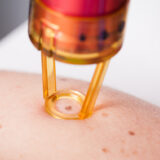
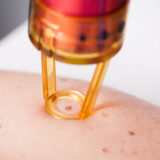
CO2 laser treatment works by vaporizing the moisture within syringoma tissue, effectively removing the lesion.
However, since the treated area may develop some scarring, other treatment options may be considered for larger lesions.
To minimize scarring, the laser is applied as superficially as possible. The level of discomfort from CO2 laser treatment varies from person to person, but in many cases it is described as similar to the sensation of a needle prick.
CO2 laser treatment also carries a low risk of bleeding. Even if a blood vessel is nicked during the ablation process, the coagulating effect of the laser causes the damaged vessel to seal almost immediately.
For more information on CO2 laser treatment and pricing, please see the following page.
Wart and Mole Removal with CO2 Laser: 3 Key Features, Pricing, and Important Considerations
Frequently Asked Questions About Syringoma
Here we have compiled answers to frequently asked questions about syringoma.
Syringoma treatment is covered by insurance when excision surgery is performed.
However, treatment with AGNES or CO2 laser is not covered by insurance.
Following your diagnosis, we will recommend a treatment plan suited to your condition, so please feel free to consult us at our clinic.
Syringoma can recur even after removal.
Even a single syringoma contains numerous cells that can form lesions, and there is a risk of recurrence both at the original site and in entirely different areas.
Taking the risk of recurrence into account, it is important to address any new lesions as they appear in order to maintain a satisfactory appearance over the long term.
Syringoma cannot be prevented or treated with medication.This is because syringoma originates in the eccrine sweat glands located in the dermis (the deeper layer of the skin). Applying medication to the skin surface cannot deliver sufficient active ingredients to the dermal layer.
Treating syringoma requires direct intervention at the affected site, such as surgical excision or laser treatment.
For Syringoma Treatment, Visit IC Clinic
Syringoma is a condition in which small bumps of approximately 1–3 mm develop just below the eyes, on the upper eyelids, or on the forehead.
While it does not cause itching or pain, many people feel self-conscious about its appearance because it tends to develop in highly visible areas.
Medication cannot treat this condition; direct intervention at the affected site is necessary, through approaches such as surgical excision or laser treatment.
At our clinic, we offer the following three treatment options tailored to each patient’s condition.
- Surgery
- AGNES
- CO2 Laser
Our specialist physicians provide thorough diagnosis and results-focused treatment, so please do not hesitate to contact us for a consultation.
Features of Syringoma Treatment at IC Clinic
At IC Clinic, our approach to syringoma treatment is distinguished by the following features.
Extensive Specialist Experience in Eye Area Treatment We have extensive experience treating delicate areas such as under the eyes and on the upper eyelids, with several hundred syringoma cases treated annually. Our meticulous technique, with careful attention to aesthetic outcomes, aims to achieve natural-looking results with minimal scarring.
Choosing the Most Suitable Option from Three Treatment Approaches We offer three treatment options—surgery, AGNES, and CO2 laser—and recommend the approach that best suits each patient’s condition, preferences, and lifestyle.
Specialist Expertise in AGNES Treatment Our clinic is one of a limited number of AGNES-certified facilities in Tokyo, with skilled physicians performing each procedure. We provide precise treatment that minimizes damage to the skin surface.
Long-Term Support with Recurrence in Mind Since syringoma carries a risk of recurrence, we provide ongoing follow-up care and retreatment support beyond the initial treatment.
Treatment Process
1. Initial Consultation & Detailed Diagnosis
- Thorough symptom interview and counseling
- Detailed examination of the affected area using a dedicated magnifying instrument
- Differential diagnosis from other conditions (milia, xanthelasma, etc.)
- Detailed explanation of treatment options and confirmation of patient preferences
- Clear presentation of the treatment plan and associated costs
2. Pre-Treatment Preparation
- Signing of consent form
- Pre-treatment photographs (for outcome assessment)
- Administration of local anesthesia (as required)
3. Treatment
- Procedure using the selected treatment method
- Monitoring of the patient’s condition throughout the procedure
- Immediate assessment of the treatment area and outcomes
4. Aftercare Guidance
- Detailed instructions on post-treatment care
- Instructions on use of prescribed medications (antibiotics and ointments)
- Scheduling of the next follow-up appointment
Detailed Comparison by Treatment Method
Surgical Treatment
Indicated for: Larger syringomas or cases with a small number of lesions Advantages:
- Covered by insurance, reducing out-of-pocket costs
- Lesion can be removed in a single session
- Lowest risk of recurrence among the available options
Disadvantages:
- Possibility of minor scarring
- Downtime of approximately one week post-procedure
AGNES Treatment
Indicated for: Cases with numerous small syringomas Advantages:
- Minimal scarring on the skin surface
- Short downtime
- Multiple lesions can be treated in the same session
Disadvantages:
- Multiple sessions required for complete removal
- Higher cost as it is not covered by insurance
CO2 Laser Treatment
Indicated for: Syringomas of moderate size Advantages:
- Low risk of bleeding
- Short treatment time
- Discomfort reduced with local anesthesia
Disadvantages:
- Possibility of recurrence due to shallow treatment depth
- Careful adjustment of treatment depth is important
Aftercare & Post-Treatment Management
Immediately After Treatment (Day of Procedure)
- Cooling of the treated area (15 minutes × 3 times)
- Application of prescribed ointment
- Facial cleansing and makeup permitted from the following day
- Avoid strong direct sunlight
First Week After Treatment
- Daily ointment application and gauze protection
- Avoid rubbing the treated area
- Use low-irritant skincare products
- Precautions during bathing
One Month After Treatment
- Thorough UV protection
- Importance of consistent moisturizing care
- Follow-up clinic visits for progress monitoring
- What to do if any abnormalities arise
Combined Treatment for Other Eye Area Conditions
The following conditions, which frequently occur alongside syringoma, can also be treated at the same time:
Milia As the same treatment devices can be used, efficient simultaneous treatment is possible.
Xanthelasma We provide comprehensive care from differential diagnosis of eyelid xanthelasma to selection of the most appropriate treatment.
Seborrheic Keratosis (Senile Warts) We can propose a comprehensive treatment plan for cases where multiple lesions appear across the face.
Blepharoptosis (Drooping Eyelids) Aesthetic improvement in conjunction with syringoma treatment can also be considered.