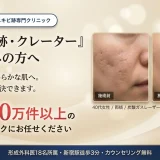

“I want to address concerns like acne scars and keloids.”
“What kind of effects can I expect from a pulsed dye laser?”
If these questions sound familiar, read on.
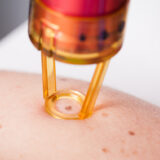
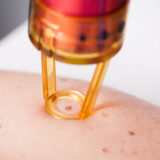
The pulsed dye laser (dye laser) is a medical laser device used to treat conditions such as telangiectasia and strawberry hemangioma. It may help improve acne scars, keloids, facial redness, and related concerns.
This page explains the principles behind the pulsed dye laser, a general guide to the number of sessions before results may appear, and potential side effects.
At our clinic, we propose a treatment plan suited to each individual patient and focus on delivering meaningful outcomes. We take the time to carefully listen to your concerns and symptoms, so please book a consultation using the button below.
Table of Contents
- 1 What Is a Pulsed Dye Laser? Treating Vascular Abnormalities with a 585 nm Wavelength
- 1.1 Indications for Pulsed Dye Laser | Treating Telangiectasia and Strawberry Hemangioma
- 1.2 How Does the Pulsed Dye Laser Work? The Mechanism Behind Symptom Improvement
- 2 Four Potential Benefits of Pulsed Dye Laser Treatment
- 2.1 Benefit ① Reducing Redness from Acne and Acne Scars
- 2.2 Benefit ② Improving Scars, Keloids, and Hypertrophic Scars
- 2.3 Benefit ③ Treatment of Corns (Viral Warts)
- 2.4 Benefit ④ Improving Hemangiomas, Red Birthmarks, and Facial Redness
- 2.5 Will the Pulsed Dye Laser Work for Me? When Might Results Appear? A General Guide to Session Numbers
- 3 Side Effects of Pulsed Dye Laser Treatment
- 3.1 Side Effect ① Mild Discomfort During Treatment
- 3.2 Side Effect ② Bruising, Redness, and Purpura as Downtime
- 4 The Pulsed Dye Laser Treatment Process
- 4.1 Post-Treatment Recovery
- 4.2 Treatment Duration and Frequency
- 5 What Is the V-Beam? One of the Pulsed Dye Laser Devices
- 6 Is Insurance Coverage Available for Pulsed Dye Laser Treatment? Partial Coverage May Apply
- 7 Pulsed Dye Laser Treatment Fees
- 8 Trust IC Clinic for Your Pulsed Dye Laser Treatment
What Is a Pulsed Dye Laser? Treating Vascular Abnormalities with a 585 nm Wavelength

The pulsed dye laser (dye laser) is a medical laser device that uses a 585 nm wavelength to treat vascular abnormalities.
Because it is highly absorbed by the color red, it rapidly targets hemangiomas. A key characteristic is its selective reactivity with abnormal blood vessels, helping to minimize impact on healthy surrounding vessels.
One pulsed dye laser device, the “V-Beam” manufactured by Syneron Candela, is capable of delivering laser energy to deeper layers of the skin.
Indications for Pulsed Dye Laser | Treating Telangiectasia and Strawberry Hemangioma
The following conditions may be suitable for pulsed dye laser treatment:
| Condition | Description |
|---|---|
| Strawberry Hemangioma | A red birthmark formed by the proliferation of immature capillaries |
| Port-Wine Stain (Nevus Flammeus) | A flat red birthmark present from birth |
| Telangiectasia | Facial redness and similar symptoms caused by dilated capillaries (e.g., from alcohol consumption) that fail to return to normal |
| Cherry Angioma (Senile Angioma) | A small tumor formed by proliferating capillaries that resembles a mole |
| Inflammatory Acne | Red acne spreading across a wide area on the face, neck, lower jaw, and similar areas |
In addition, redness associated with scars, keloids, and hypertrophic scars resulting from burns or trauma may also be treated.
The dye laser can be used to treat children as well.
How Does the Pulsed Dye Laser Work? The Mechanism Behind Symptom Improvement
The pulsed dye laser treats vascular lesions through the following mechanism:
- The laser is absorbed by oxyhemoglobin in red blood cells
- The absorbed laser light is converted into thermal energy
- The heated red blood cells damage the surrounding capillaries
- The damaged capillaries become occluded
- The thermally destroyed vessels are replaced by normal tissue
This treatment works by directing pulsed dye laser energy at the affected capillaries, encouraging them to transition into healthy, normal capillaries.
In most cases involving vascular lesions other than cherry angiomas, a single session is not sufficient to treat all affected vessels. As a result, multiple sessions — typically three to five — are generally required.
Four Potential Benefits of Pulsed Dye Laser Treatment

The following four benefits may be expected from pulsed dye laser treatment:
- Reducing redness from acne and acne scars
- Improving scars, keloids, and hypertrophic scars
- Treatment of corns (viral warts)
- Improving hemangiomas, red birthmarks, and facial redness
Each of these is explained in detail below.
Benefit ① Reducing Redness from Acne and Acne Scars
Pulsed dye laser treatment may help reduce the redness associated with acne and acne scars.
Acne and acne scars involve the proliferation of new blood vessels due to inflammation. By targeting these excess blood vessels with the pulsed dye laser and helping to reset the inflammatory response, redness may be reduced.
Red acne can result from sudden inflammation or may persist chronically as residual scarring.
Because both involve an ongoing inflammatory process, the pulsed dye laser may be beneficial for either type.
Benefit ② Improving Scars, Keloids, and Hypertrophic Scars
Pulsed dye laser treatment may also help improve the appearance of scars, keloids, and hypertrophic scars.
Keloids and hypertrophic scars are conditions in which scar tissue becomes raised. They can appear in various colors including white and red; the pulsed dye laser is particularly suited to treating red or pink scars, keloids, and hypertrophic scars.
For hypertrophic scars, another procedure may first be used to flatten the raised area, after which the pulsed dye laser may be applied to address residual redness.
Benefit ③ Treatment of Corns (Viral Warts)

The pulsed dye laser is also used to treat corns, a type of viral wart.
Treatment begins with excision at the boundary between the epidermis and dermis. Because a small amount of virus may remain after excision, the pulsed dye laser is then applied to the excised area.
The heat from the pulsed dye laser helps to eliminate the residual virus, reducing the likelihood of recurrence.
An alternative method for removing corns involves using carbon dioxide (CO₂) laser to excise the lesion from the root, though healing may take approximately one month.
Pulsed dye laser treatment may require multiple sessions; however, because healing tends to be faster, patients are generally able to walk normally on the day of treatment.
Benefit ④ Improving Hemangiomas, Red Birthmarks, and Facial Redness
The pulsed dye laser (dye laser) may be used to address skin redness including hemangiomas, red birthmarks, and facial redness (Rosacea / Facial Redness).
A hemangioma is a condition in which capillaries proliferate abnormally, producing small red spots resembling moles — also referred to as “red birthmarks.” Facial redness, on the other hand, is caused by dilated capillaries and other factors, and like hemangiomas, involves abnormalities of the capillary vessels.
By targeting and reducing abnormal capillaries, the pulsed dye laser may help improve hemangiomas and facial redness.
The pulsed dye laser may also be effective for rosacea — a condition characterized by redness and breakouts in localized areas such as the cheeks and sides of the nose.
Will the Pulsed Dye Laser Work for Me? When Might Results Appear? A General Guide to Session Numbers
Some patients may not notice significant improvement after a single pulsed dye laser session, as the severity and extent of each condition varies from person to person.
The number of sessions needed before results may be noticed varies among individuals; as a general guide, three or more sessions are often recommended.
The number of sessions required depends on the specific concern and symptoms — in some cases, redness may begin to fade after just one session.
If you are wondering how many sessions may be needed for your particular concern, please consult with one of our physicians before beginning treatment.
Side Effects of Pulsed Dye Laser Treatment

There are two potential side effects associated with pulsed dye laser treatment that should be considered before proceeding:
- Mild discomfort during treatment
- Bruising, redness, and purpura as part of the downtime period
Each of these side effects is described in more detail below.
Side Effect ① Mild Discomfort During Treatment
During pulsed dye laser treatment, you may experience a sensation similar to being snapped with a rubber band.
This discomfort occurs as the red pigment is being targeted and is not an abnormal response.
Any discomfort after the procedure typically subsides within a few hours to two days. If you experience a stinging or burning sensation, cooling the treated area may help provide relief.
Side Effect ② Bruising, Redness, and Purpura as Downtime
The following symptoms may occur during the downtime period after pulsed dye laser treatment:
- Bruising (purpura)
- Redness
- Swelling
- Post-inflammatory hyperpigmentation
and others.
Bruising and purpura occur most commonly after treatment of port-wine stains, but in many cases these symptoms improve within one to two weeks.
Swelling may also occur, giving the area a puffy appearance, and the heat from the laser may trigger post-inflammatory hyperpigmentation. Swelling tends to become less noticeable within about one week, while hyperpigmentation generally resolves on its own over the course of several months.
The Pulsed Dye Laser Treatment Process

The pulsed dye laser treatment process is as follows:
- Consultation
The number and location of the areas to be treated (birthmarks, pigmented spots, etc.) are confirmed. A detailed explanation of the proposed treatment plan is provided. - Treatment
Protective goggles are worn before the procedure begins. You may feel a sensation similar to being snapped with a rubber band during treatment. - Post-Treatment Care
The treated area is assessed to evaluate the outcome. Medication or protective tape may be prescribed depending on the condition.
You are able to return home on the same day; however, please take care to avoid sun exposure afterward.
Please also avoid bathing on the day of treatment.
If multiple sessions are required, visits are generally scheduled once every few months.
Post-Treatment Recovery
The typical post-treatment recovery timeline is as follows:
| Time After Treatment | Expected Progress |
|---|---|
| Day of Treatment | ・The treated area may appear red ・The skin over the treated area may lift and peel as the pigment is broken down ・A stinging or burning sensation typically subsides within a few hours |
| Day of Treatment – Following Day | ・A scab may form over the treated area ・Bathing is generally permitted from this point |
| Several Days After Treatment | ・The scab naturally falls off, revealing pink skin beneath ・A follow-up visit for observation may be recommended in some cases |
| Approximately 4 Weeks After Treatment | ・The pink skin gradually returns to a more natural tone ・Sun protection (sunscreen) should be used to guard against UV exposure |
Please be careful not to rub or irritate the treated area after your session.
Treatment Duration and Frequency
Each pulsed dye laser session typically takes between a few seconds and a few minutes.
Treatment frequency varies depending on the procedure; when insurance coverage applies, sessions must be spaced at least three months apart. For self-pay treatments, sessions are generally scheduled approximately once a month.
Pulsed dye laser treatment involves repeated sessions at appropriate intervals.
When the condition covers a larger area, sessions may take longer, and the overall course of treatment may extend over a longer period.
What Is the V-Beam? One of the Pulsed Dye Laser Devices

The V-Beam is one of the medical devices used for pulsed dye laser (dye laser) treatment.
In addition to potential benefits for facial redness and hemangiomas, the V-Beam may also support skin beautification — including the appearance of fine lines and improvements in skin firmness and radiance.
It also features a cooling mechanism designed to help minimize discomfort and reduce the burden on the skin during treatment.
At our clinic, we use the “V-Beam Prima” or “V-Beam II” — updated models within the V-Beam series.
For more information about the V-Beam, please also refer to the following page:
V-Beam: Benefits and Downtime — Treating Telangiectasia and Facial Redness with Insurance Coverage
Is Insurance Coverage Available for Pulsed Dye Laser Treatment? Partial Coverage May Apply

Of the conditions treatable with the pulsed dye laser, the following three are eligible for insurance coverage:
- Strawberry hemangioma
- Port-wine stain (nevus flammeus)
- Telangiectasia in superficial layers of the skin
Treatment of inflammatory acne, cherry angiomas, scars, keloids, and hypertrophic scars is provided on a self-pay basis.
V-Beam treatments aimed at reducing fine lines or improving skin firmness are also not covered by insurance.
Pulsed Dye Laser Treatment Fees

V-Beam (pulsed dye laser) fees at our clinic vary depending on the treatment area and specific concerns.
Please refer to the fee schedules below, organized by concern, for detailed V-Beam pricing:
Fee Schedule: Redness & Facial Redness
Fee Schedule: Skin Beautification & Radiance
Fee Schedule: Acne Scars (Redness)
Trust IC Clinic for Your Pulsed Dye Laser Treatment
The following four benefits may be expected from pulsed dye laser (dye laser) treatment:
- Reducing redness from acne and acne scars
- Improving scars, keloids, and hypertrophic scars
- Treatment of corns (viral warts)
- Improving hemangiomas, red birthmarks, and facial redness
The pulsed dye laser targets vascular abnormalities and may be used in the treatment of telangiectasia and strawberry hemangioma.
Our clinic’s pulsed dye laser device, the V-Beam, may also offer skin beautification benefits. If you are concerned about red acne scars or facial redness, please feel free to consult with us.
At our clinic, we propose a treatment plan suited to each individual patient and focus on delivering meaningful outcomes. We take the time to carefully listen to your concerns and symptoms, so please book a consultation using the button below.